
Early Clocks | Lee Borrett


John Sanderson
c1698
A
17th century
Primitive Longcase, 1698
The wonderfully interesting and unrestored late seventeenth-century 30-hour longcase clock illustrated here was made by John Sanderson of Wigton around c.1698 and survives in a remarkably primitive oak case with back splat. Its two-handed 11-inch square brass dial has Sanderson’s characteristic religious verse deeply engraved across the dial centre:
‘Remember man die thou must,
And after that to Judgement Just’.
The verse is engraved around a square calendar aperture positioned in the lower part of the dial centre. The relationship between the engraving and the date aperture strongly suggests that Sanderson cut the calendar square before engraving the surrounding verse.
This clock is especially interesting because, unlike many of Sanderson’s early 30-hour clocks which may originally have stood upon simple wall brackets, this example survives in a wonderfully primitive longcase which appears entirely appropriate to its very early date. The case itself is of particularly rustic construction, with a pegged oak hood, back splat and external iron blacksmith-made hinges to both the trunk and hood doors. These features give the clock an exceptionally early and provincial character and make it an important survivor from the formative years of the Wigton School.
The Dial


Above. Showing a close-up of the simple ‘John Sanderson’ signature and the distinctive trident-type half-hour markers. Photographed by Lee Borrett.
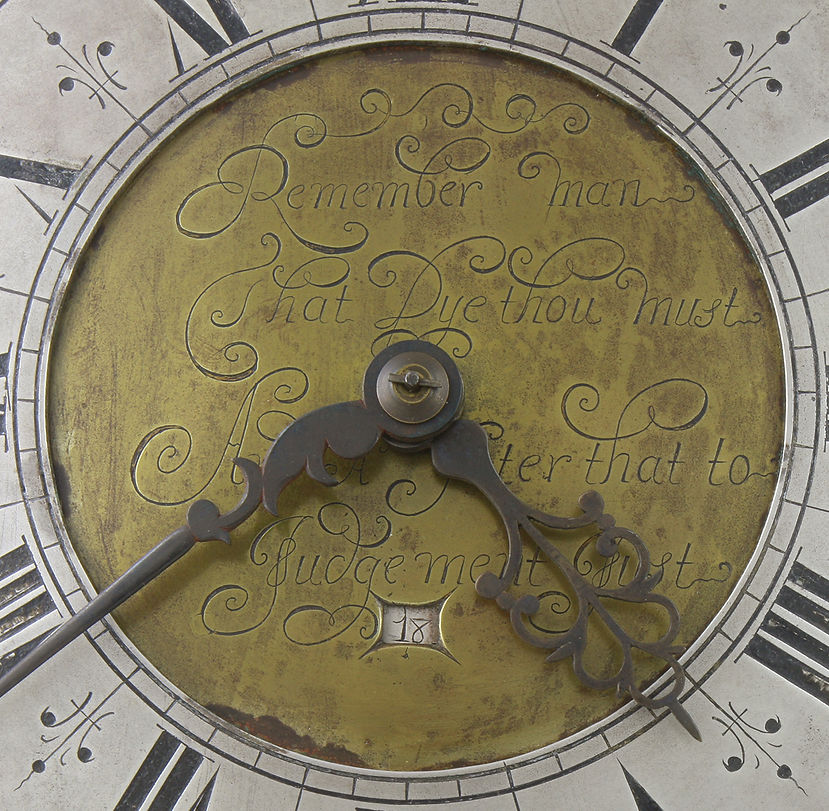
Above. Showing a close-up of the wonderfully unrestored and tarnished dial centre with Sanderson’s deeply engraved religious verse: ‘Remember man die thou must, And after that to Judgement Just’. Photographed by Lee Borrett.
John Sanderson
The Engraver

Above. The reverse of the chapter ring reveals some of John Sanderson’s practice engraving, including the capital letter ‘J’, presumably for John. Photographed by Lee Borrett.

Above. Further practice engraving by John Sanderson, including the capital letter ‘S’, presumably for Sanderson. Photographed by Lee Borrett.
Below. Another example of Sanderson’s practice engraving, this time showing a capital ‘R’, possibly used in preparation for the word ‘Remember’. Note the visible slip made with the engraving tool. Photographed by Lee Borrett.

The Movement

Above. Showing a rear view of the late seventeenth-century John Sanderson 30-hour movement. Its heavily constructed brass and iron birdcage movement, lantern-style pillars and distinctive pyramid-shaped back cock are all characteristic of Sanderson’s early work. Photographed by Lee Borrett.
Below. Showing the top plate of the John Sanderson lantern-type movement.Photographed by Lee Borrett.

From my own experience of collecting and studying Sanderson’s early clocks, I believe many of his 30-hour movements with decorative lantern-style brass pillars may originally have been sold as relatively inexpensive wall clocks, standing upon simple brackets with their movements fully exposed.
The primitive longcase illustrated here is therefore particularly interesting because it demonstrates that some customers were evidently prepared to house these early movements in wooden cases from an early date. Whether this case was supplied at the exact moment the clock was made cannot now be proved, but its wonderfully primitive construction appears entirely consistent with the clock’s late seventeenth-century character.
The surviving Edinburgh records provide important later evidence of how widely Sanderson was prepared to travel in search of customers. In May 1715 the Edinburgh Incorporation of Hammermen recorded that he was offering two clocks for sale there. The clocks were seized because he was not a freeman of the Incorporation, but were returned to him upon payment of twenty shillings sterling. Three days later he entered into a bond undertaking not to bring clocks, watches or similar work into Edinburgh for sale again.
We cannot know what form those two clocks took, or whether they were housed in longcases. Nevertheless, the episode demonstrates that Sanderson’s market eventually extended far beyond Wigton and Cumberland.
The late Brian Loomes also suggested that some of these distinctive lantern-style 30-hour movements may originally have stood upon wall brackets rather than necessarily being housed immediately in longcases. Such an arrangement would have reduced the initial cost and made the clocks considerably easier to transport. The clock illustrated here provides a fascinating contrast. While many early Sanderson movements may initially have remained uncased, this example appears to have spent much of its long life housed in a wonderfully primitive oak longcase, demonstrating that both forms could coexist within the early Wigton tradition.
The Wonderfully Primitive
Oak Case


Above. Showing the wonderfully primitive pegged oak longcase with back splat and external iron blacksmith-made hinges to both the trunk and hood doors. The hood was constructed to accommodate side windows, although close inspection shows that glass appears never to have been fitted. Photographed by Lee Borrett.
Below. Showing a close-up of one of the external iron blacksmith hinges. Photographed by Lee Borrett.

Below. Showing the John Sanderson lantern-type movement standing upon its oak blocks. Photographed by Lee Borrett.

Below. Showing a front view of the wonderfully primitive pegged oak hood.
Photographed by Lee Borrett.

John Sanderson and
Tiffinthwaite
John Sanderson was born in 1671 and spent much of his childhood at Tiffinthwaite Farm, near Wigton, where his father Robert worked as the resident blacksmith and the family are believed to have lived within the farm buildings. Tiffinthwaite was one of the earliest centres of Quakerism in Cumberland and was closely associated with the Pearson family and the early Society of Friends. Following the death of his father, Sanderson later became closely connected with the Pearson family himself and in 1691 married Elizabeth Pearson, granddaughter of William Pearson of Tiffinthwaite.
It has long been suggested that Sanderson may have trained under the Quaker clockmaker John Ogden of Bowbridge in Yorkshire during the 1680s. No apprenticeship indenture has yet been found to prove this, although similarities between their surviving clocks suggest that Sanderson may have been influenced by, or trained within, the same horological tradition. By the early 1690s Sanderson was back in the Wigton district and had begun producing the distinctive clocks that would form the foundation of what has become known as the Wigton School of Clockmaking.
Summary
This wonderfully primitive 30-hour longcase clock dating from around c.1698 is an important survivor from the earliest years of John Sanderson’s career and the formative period of the Wigton School of Clockmaking. Its deeply engraved religious verse, blank dial corners, trident-type half-hour markers, simple ‘John Sanderson’ signature and heavily constructed lantern-style movement all belong to the distinctive language of Sanderson’s earliest work. The clock is also particularly important because it survives in a primitive pegged oak longcase with back splat and external iron blacksmith-made hinges. While many of Sanderson’s early 30-hour clocks may originally have been sold as uncased wall clocks, this example demonstrates that some were housed in wooden longcases at a very early date. The practice engraving preserved on the back of the chapter ring provides another fascinating and unusually personal connection with Sanderson himself, allowing us to see traces of the working process behind the finished dial.
For me, the great attraction of this clock lies in its complete lack of sophistication. The crude oak case, blacksmith-made hinges, deeply engraved religious dial and substantial movement combine to create a wonderfully honest provincial clock that takes us very close to the world in which John Sanderson was working at the end of the seventeenth century.
Acknowledgement
I would like to acknowledge the pioneering research of the late Brian Loomes, whose work did more than anyone else’s to advance our understanding of John Sanderson and the Wigton School of Clockmaking.
His book Brass Dial Clocks contains an important chapter devoted to the Wigton School, while his numerous published articles remain essential reading for collectors and historians interested in these remarkable Cumbrian clockmakers.
Much of the historical and horological background used in preparing this article has been informed by the published research of the late Brian Loomes. I have also incorporated observations from my own study and collection of surviving Wigton clocks, together with additional information and documentary evidence that has come to light since his original research was published.
As further clocks and historical records continue to emerge, our understanding of John Sanderson and the Wigton School continues to develop.
Brian Loomes’s published work remains a standard point of reference for British clockmakers and antique clocks, and specialist sources continue to describe his contribution to horological research as substantial.

The silvered chapter ring has distinctive trident-type half-hour markers and is signed at the bottom simply ‘John Sanderson’, without the place name Wigton. The absence of a place name is particularly interesting. It is possible that Sanderson sometimes omitted ‘Wigton’ on clocks intended for sale beyond his immediate locality, perhaps through markets or while travelling in search of customers. The surviving Edinburgh records now show that by 1715 he was indeed carrying clocks considerable distances for sale.
However, the signature alone cannot prove where this particular clock was intended to be sold, and given its very early date of around c.1698, I would regard the missing place name as an intriguing feature rather than evidence in itself. All four corners of the dial were made without spandrels and have been left completely blank, a feature seen on a number of Sanderson’s earliest surviving clocks.
Above. Showing the unrestored John Sanderson 11-inch square brass dial with blank corners and a religious-versed dial centre. Photographed by Lee Borrett.