
Early Clocks | Lee Borrett
Of
Wigton, c1695


An exceptionally rare early eight-day religious-versed longcase clock by John Sanderson of Wigton, dating from the early 1690s and presently believed to be his earliest surviving eight-day example. Its deeply engraved Memento Mori verses, early dial features and substantial movement place it amongst the most important surviving clocks from the formative years of the Wigton School. Click here to view my full article. Click here to view article. Private collection, Photographed by Lee Borrett.
Wigton Fecit, c1700


This wonderfully evocative religious-versed 30-hour longcase clock was made by John Sanderson of Wigton around 1700. Its polished brass dial is deeply engraved with the solemn Memento Mori verse, ‘Remember man, That Die thou must, And after that, To judgement just’, while the primitive early oak case, with hanging barley-twist pillars and no true base, adds greatly to its remarkable character. Particularly intriguing are the initials and the date 1703 fixed to the front panel, together with what appears to be a small cross-like motif, perhaps commemorating a family or marriage event, although its exact meaning remains uncertain. Click here to view my full article. Click here to view article. Private collection, Photographed by Lee Borrett.
Wigton Fecit, c1700


Sleeping Beauty. This wonderfully evocative and highly original early 30-hour religious-versed wall clock by John Sanderson of Wigton dates from around 1700 and survives in remarkably untouched condition. Its deeply engraved religious dial, rare penny moon feature and substantial early Wigton-style movement give it exceptional character, while its wonderfully unrestored state offers a rare glimpse of a provincial clock that has come down to us with much of its early history still intact. Click here to view article. Private collection, Photographed by Lee Borrett.
Wigton Fecit, c1710


The religious character of this remarkable early Sanderson clock is immediately apparent. Unlike many surviving Wigton dials, where a single devotional inscription accompanies the timekeeping functions, almost the entire nine-inch brass dial is devoted to religious admonition. The unusually concentrated use of multiple verses, combined with the small scale of the dial and the possibility that the clock was originally intended for use without a longcase, makes this an exceptionally evocative survivor from the early religious tradition of the Wigton School. Click here to view article. Private collection, Photographed by Lee Borrett.
Wigton Fecit, c1705


This wonderfully interesting early religious-versed 30-hour wall clock was made by Richard Sill of Wigton around 1705 and belongs firmly within the early Wigton School tradition centred upon John Sanderson. Its polished brass dial is deeply engraved with the solemn Memento Mori verse, ‘Remember man, That Die thou must, And after that, To judgement just’, a form also found on early clocks by Sanderson. The absence of applied corner spandrels, substantial brass-and-iron lantern-style movement and rare penny moon feature all combine to give this remarkable clock its distinctive early Wigton character. Click here to view article. Private collection, Photographed by Lee Borrett.
Oulton Fecit, c1705
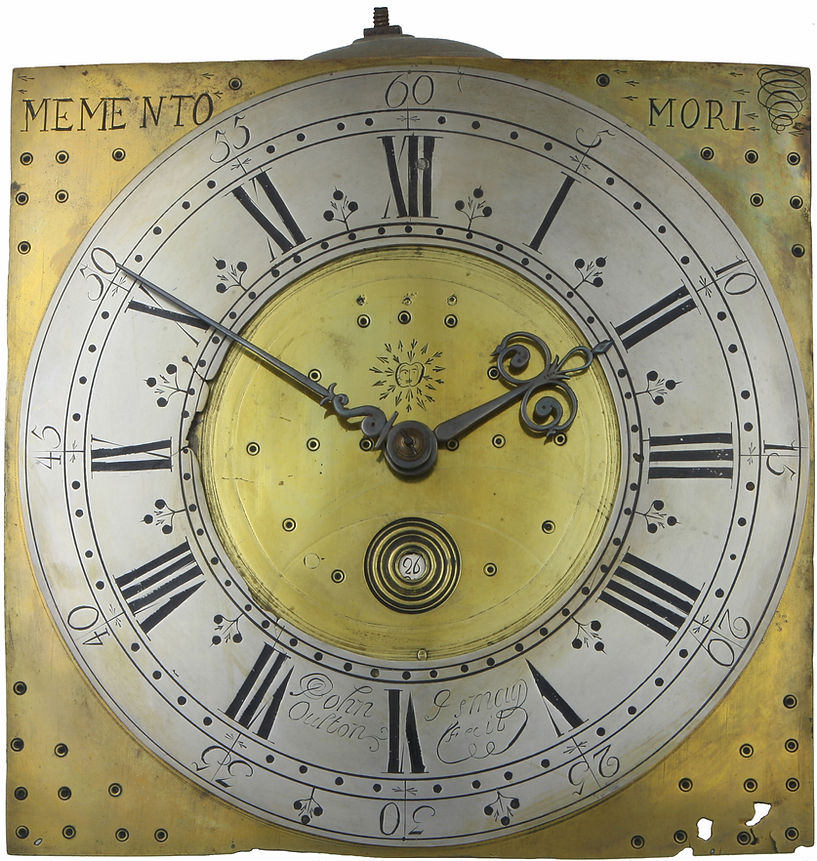

This fascinating and wonderfully primitive 30-hour religious clock was made by John Ismay of Oulton around 1715 and may be the earliest surviving clock presently known by this important northern maker. Its exceptionally rustic dial, engraved with the Memento Mori inscription, together with its substantial brass-and-iron lantern-style movement, suggests a clock made very early in Ismay’s career, possibly during the latter years of his apprenticeship to John Ogden or shortly afterwards. The crude casting faults, irregular engraving and wonderfully unsophisticated construction give it exceptional character and provide a rare glimpse into the formative years of a craftsman who would later become closely associated with the Wigton clockmaking tradition. Housed today in a primitive oak longcase, the clock may originally have been intended for use without a case, perhaps upon a wall bracket. Click here to view article. Private collection, Photographed by Lee Borrett.
Wigton Fecit, c1710


This exceptionally rare early religious-versed 30-hour clock by John Ismay of Wigton dates from around 1718 and may be his earliest surviving clock signed from Wigton, following his earlier Oulton work. The wonderfully primitive dial is deeply engraved with the solemn verse, ‘Shun Sin least thou Lament, When Precious Time is Spent, And Death to the(e) is Sent, No Time then to Repent’, while the words Memento Mori are engraved in the upper corners. Particularly remarkable is the number ‘1’ engraved on the back of the dial beneath the calendar wheel. Other early 30-hour clocks by Ismay are known bearing the numbers 5 and 7, suggesting that this clock formed part of an early numbered sequence, although whether ‘No.1’ literally represents his first Wigton clock cannot now be proved. Housed today in a rustic pine longcase that appears to post-date the movement, this wonderfully evocative survivor provides a fascinating glimpse into the early work of one of the most distinctive makers associated with the Wigton School. Click here to view article. Private collection, Photographed by Lee Borrett.
Wigton Fecit, c1710


This exceptionally rare and wonderfully unrestored early eighteenth-century religious 30-hour clock was made by Henry Sheppard of Wigton around 1710 and is presently believed to be the only known surviving clock by this little-recorded maker. Its polished brass dial is deeply engraved with the solemn Memento Mori verse, ‘Remember man, That Dye thou must, And after that, To judgement just’, a form also found on early clocks by John Sanderson and one that places Sheppard firmly within the religious clockmaking tradition of the Wigton School. The substantial brass-and-iron lantern-style movement survives in remarkably original condition, retaining its original wheelwork and collets.
The clock is housed today in a wonderfully atmospheric green-lacquered oak longcase with caddy top and finials, which appears to have been associated with the movement at a later date, probably around c.1740. The applied corner spandrels also seem likely to belong to this later phase, when the earlier religious wall clock was adapted to suit the richer fashion of the period. Like several other early Wigton clocks with lantern-style movements, it may originally have been intended for use without a longcase, perhaps upon a wall bracket, although this remains an intriguing possibility rather than something that can now be proved. Click here to view
article. Private collection, Photographed by Lee Borrett.

Fecit, hoc Horologi


This exceptionally unusual early eight-day longcase clock, dating from around 1700, is boldly signed ‘Joseph Calvert Fecit hoc Horologium’ — ‘Joseph Calvert made this clock’. Calvert was a yeoman farmer of Longthwaite, near Wigton, rather than a conventional professional clockmaker, and the remarkable construction of the clock suggests that it may have been made as a private undertaking, possibly with assistance from the young John Sanderson, whose family lived nearby and was known to the Calvert family. The clock therefore provides a fascinating glimpse into the close-knit rural community from which the Wigton School of Clockmaking emerged. Click here to view article. Private collection, Photographed by Lee Borrett.

Wigton Fecit, c1715

This wonderfully original and untouched 30-hour religious wall clock by John Sanderson dates from around 1715 and is distinguished by its beautifully engraved all-over tulip dial. A single tulip flower crowns the dial centre above the calendar aperture, while Sanderson’s solemn Memento Mori verse, ‘Remember Man Die thou must, And after that to judgement just’, is deeply engraved below. Flowing foliage, tulip decoration and unusual wriggle-work surround the chapter ring, which carries distinctive trident-style half-hour markers with arrowheads. Signed simply ‘John Sanderson’, without a place name, this remarkable clock provides a fascinating example of the decorative variety found within Sanderson’s later religious work. Click here to view article. Private collection, Photographed by Lee Borrett.
Wigton Fecit, c1698

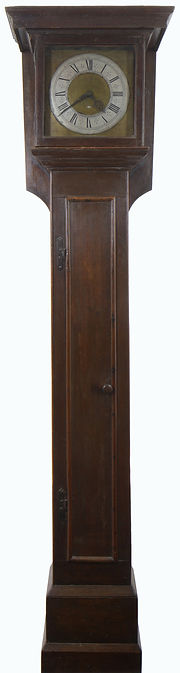


This wonderfully evocative and unrestored late seventeenth-century 30-hour longcase clock was made by John Sanderson of Wigton around 1698 and is housed in a remarkably primitive pegged oak case with a distinctive back splat and external blacksmith-made iron hinges to both the trunk and hood doors. Its two-handed 11-inch square brass dial is deeply engraved with the solemn Memento Mori verse, ‘Remember man die thou must, And after that to Judgement Just’, arranged around a square calendar aperture in the lower dial centre. The wonderfully honest condition of both clock and case gives this rare survivor exceptional character and provides a fascinating glimpse into the rustic domestic world of the early Wigton School. Please Click here to view article. Private collection, Photographed by Lee Borrett.
Skelton Fecit, c1698


This wonderfully interesting early religious clock dial (only), signed ‘Redge Buckele Skelton Fecit’, survives as a rare fragment from the wider Wigton School tradition. Its deeply engraved Memento Mori inscription, distinctive half-quarter band and unusual candle-style half-hour markers all give the dial considerable character, while the surviving fixing arrangement at the rear provides further evidence of its relationship with early Wigton clockmaking practice. Discovered and researched by Dr William Linnard, this remarkable survivor offers a fascinating glimpse into the work of a little-known provincial maker whose clockmaking connections might otherwise have been lost. Click here image to view article. Private collection, Photographed by Lee Borrett.

Oulton Fecit, c1698

The primitive brass dial (only) illustrated here is most interesting. It was made by John Ismay of Oulton (near Wigton) from around c1720. It has the religious verse 'memento Mori' (Bear Death in Mind), engraved to the dial centre along with some cup-and-ringing. However, to the top two corners there are also winged-cherubs that are up in the clouds and looking down whilst blowing a trumpet and shooting arrows from a bow. The trident half-hour markings are detached and the dial is signed on the chapter ring 'John Ismay, Oulton Fecit' (Made it). Click here to view article. Private collection, Photographed by Lee Borrett.
