
Early Clocks | Lee Borrett

John Ismay's earliest Wigton clock as a professional clockmaker. A wonderfully interesting early religious versed wall clock by John Ismay of Wigton, near Wigton. Photograph by Lee Borrett.

John Ismay
Wigton Fecit, c1718
The fabulous early religious-versed clock illustrated here is an exceptionally rare and historically important example by John Ismay of Wigton. Dating from around c.1718, it is presently the earliest surviving signed Wigton clock by Ismay known to me, although it should not be confused with his slightly earlier clock signed at Oulton. Originally, this clock was almost certainly made to stand on a simple wall bracket, leaving its substantial brass and iron lantern-type movement exposed. Remarkably, it survives today in a very original condition and is housed in a wonderfully primitive pine longcase which I believe was made specifically for the clock around twenty years later, rather than being a later marriage.
Importantly, the case still retains its original pine seat board and original pine turn buckle, providing further evidence that the longcase was purpose-made for this clock. The case was originally painted, but at some later stage the paint was stripped away, probably because the original painted surface had become badly worn or deteriorated. The exposed pine was then stained and polished, resulting in the finish seen today.
At approximately the same time that the clock was housed in its purpose-made longcase, four brass spandrels were added to the dial. In doing so, the two upper spandrels concealed the original engraved words ‘MEMENTO MORI’ in the upper corners. Even more remarkable is the religious verse engraved across the polished dial centre:
‘Shun Sin least thou Lament,
When Precious Time is Spent,
And Death to the(e) is Sent,
No Time then to Repent.’
The verse, together with the hidden ‘MEMENTO MORI’ inscription, places this clock firmly within the distinctive religious tradition associated with the early Wigton School of Clockmaking. Perhaps most fascinating of all is the engraved number ‘1’ on the back of the dial, now concealed behind the calendar wheel. From other surviving clocks we know that John Ismay numbered at least some of his early Wigton clocks, with examples bearing the numbers 5 and 7 also having come to light. If these numbers represent a genuine production sequence, the hidden No. 1 on this clock makes it an extraordinary survivor from the very beginning of Ismay’s career as a Wigton clockmaker.
From Wigton to Edinburgh
An extraordinary glimpse into the world in which these earliest Wigton clocks were made comes from the records of the Edinburgh Hammermen. On 18 May 1715, only a few years before this John Ismay clock was made, two clocks belonging to his elder stepbrother John Sanderson of Wigton were seized after Sanderson had apparently taken them to Edinburgh for sale. The records describe him as ‘John Sanderson, clockmaker in Wigtoun in England’ and state that his two clocks were returned after he paid twenty shillings sterling and agreed not to bring clocks or watches into Edinburgh for sale again. The discovery is particularly fascinating when looking at early Wigton clocks such as the Ismay example shown here. Before being placed in longcases, clocks of this type could stand on relatively simple wall brackets, leaving their substantial lantern movements exposed. There is, of course, no evidence that this particular John Ismay clock ever travelled to Edinburgh. Nevertheless, Sanderson’s documented journey demonstrates that clocks from the Wigton School were already being carried considerable distances in search of customers by 1715, and helps us understand why a relatively compact uncased wall clock could have been such a practical form of provincial clockmaking.
The Dial
Above. Showing the wonderfully interesting John Ismay dial. The four brass spandrels were probably added around c.1735–1740, when the clock was housed in its purpose-made primitive pine longcase, consequently concealing the original ‘MEMENTO MORI’ engraving in the two upper corners. Photograph by Lee Borrett.

Above. Showing a close-up of the John Ismay polished dial centre with the religious verse that reads:- ' Shun Sin least thou Lament, When Precious Time is Spent, And Death to the(e) is Sent, No Time then to Repent.' Photograph by Lee Borrett.

Above. A close-up of John Ismay’s signature, ‘John Ismay, Wigton Fecit’. Photograph by Lee Borrett.

Above. Showing a close-up of the top right-hand twin-cherub spandrel with crossed maces. The spandrels were probably added around c.1735–1740, when the clock was housed in its primitive pine longcase. Interestingly, this spandrel conceals part of John Ismay’s original engraving and still retains traces of its early gilding. Photograph by Lee Borrett.

Above. Showing the John Ismay dial with the later spandrels removed, revealing the original ‘MEMENTO MORI’ inscription in the two upper corners and the two plain lower corners. The later spandrel fixing holes have been digitally removed from the photograph simply to illustrate how the dial may originally have appeared around c.1718, before the clock was housed in its longcase. Photograph by Lee Borrett.

Above. The top left hand corner has arrow head markings by the side of the word 'MEMENTO'. Photograph by Lee Borrett.

Above. The top right hand corner the word 'MORI' plus a spiral engraving. Photograph by Lee Borrett.

Above. Perhaps one of the most historically significant details on the clock: engraved on the back of the dial and normally hidden beneath the calendar wheel is the number ‘1’. Other early clocks by John Ismay are known bearing the numbers 5 and 7, suggesting that he numbered at least some of his earliest Wigton clocks. Photograph by Lee Borrett.
The Movement

Above. Showing a rear view of the John Ismay iron and brass birdcage movement. Note the beautifully turned brass movement pillars and fancily shaped back-cock. Photograph by Lee Borrett.

Above. Showing an angled view of the John Ismay iron and brass birdcage movement. Photograph by Lee Borrett.

Above. Showing a side view of the John Ismay iron and brass birdcage movement. Photograph by Lee Borrett.

Above. Showing the top plate of the John Ismay movement. Typically on these early Wigton School clocks, the movement is secured to the dial from the top plate by two pins. Photograph by Lee Borrett.

Above. Showing another view of the John Ismay top plate. Photograph by Lee Borrett.
The Pine Case
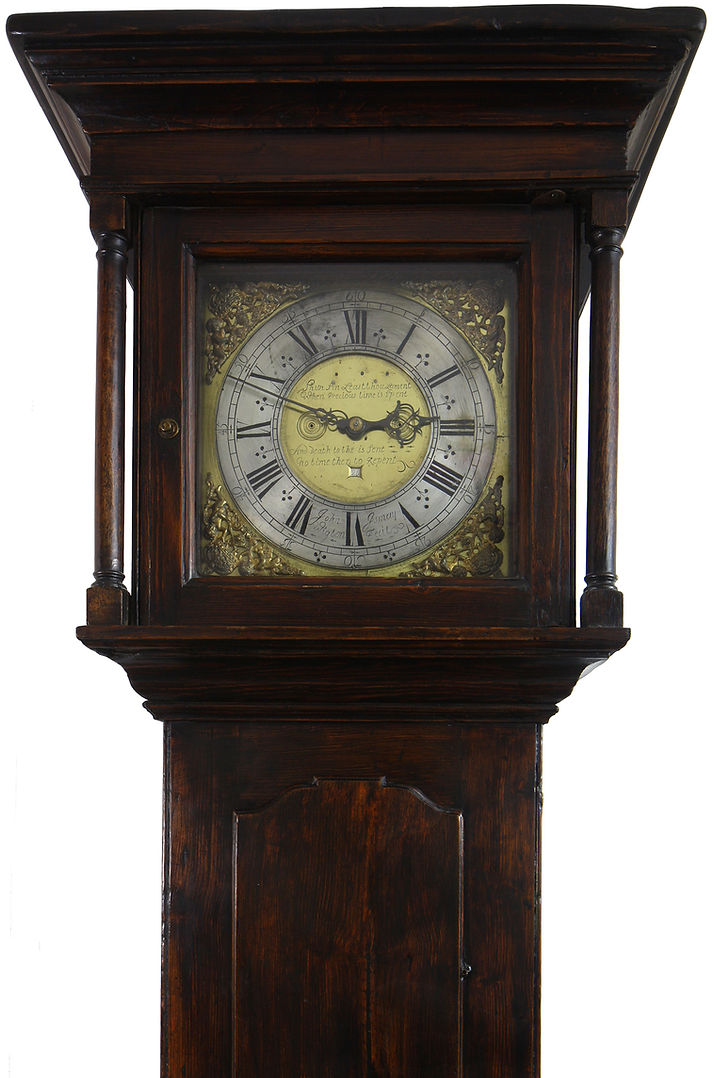

Above. Showing the John Ismay clock housed in its wonderfully primitive pine longcase. I believe the clock was originally made around c.1718 to stand on a simple wall bracket, with its substantial iron and brass movement fully exposed.
The present pine case was probably made specifically for this clock around c.1735–1740. Although therefore around twenty years later than the movement, I believe it is original to the clock rather than a later marriage. Importantly, the case still retains its original pine seat board and original pine turn buckle, providing strong physical evidence that the case was purpose-made to receive this particular clock. The case was originally painted, but at some later stage the paint was stripped off, probably because the original surface had become badly worn or deteriorated. The exposed pine was then stained and polished, resulting in the finish seen today. At approximately the same time that the clock was housed in its longcase, the four brass spandrels were added to the dial, consequently concealing the original ‘MEMENTO MORI’ inscription in the upper corners.
Photograph by Lee Borrett.
Below. Showing the original turnbuckle on the inside of the trunk door. Photograph by Lee Borrett.

Summary
This remarkable clock is an historically important survivor from the formative years of the Wigton School of Clockmaking and is presently the earliest surviving clock signed by John Ismay at Wigton known to me.
John Ismay was born at Thursby, near Wigton in Cumberland, in March 1699. In 1711 he was apprenticed to the celebrated Yorkshire Quaker clockmaker John Ogden of Bowbridge, although he appears to have returned to the Wigton area before completing the conventional term of his apprenticeship. By around 1717–1718 he was working in Cumberland and was closely associated with the distinctive clockmaking tradition established by his much older stepbrother, John Sanderson.
The clock illustrated here provides an extraordinary glimpse into those early years. Its substantial iron and brass birdcage movement, religious verse, hidden ‘MEMENTO MORI’ inscription and beautifully primitive construction are all characteristics which place it firmly within the early Wigton tradition. Most remarkable of all is the engraved number ‘1’ hidden behind the calendar wheel on the back of the dial. Other surviving John Ismay clocks bearing the numbers 5 and 7 suggest that at least some of his earliest Wigton clocks were numbered in sequence. Although we cannot prove precisely what Ismay intended by these numbers, the survival of No. 1 on this clock makes it especially significant.
Originally probably made as a wall clock around c.1718, this remarkable clock appears to have remained in that form until around c.1735–1740, when I believe its wonderfully primitive pine longcase was made specifically for it and the four brass spandrels were added to the dial. Although the case therefore dates from a later stage in the clock’s early life, I regard it as original to the clock rather than a later marriage.
The survival of its original pine seat board and original pine turn buckle further supports this interpretation. The case was originally painted, but the paint was later stripped away, probably after the original finish had deteriorated, and the exposed pine was subsequently stained and polished.
Together, the clock, its religious verse, hidden ‘MEMENTO MORI’, numbered dial and early purpose-made case take us remarkably close to John Ismay and the formative years of the Wigton School of Clockmaking.
Acknowledgement
The late Brian Loomes was the authority on John Sanderson and The Wigton 'School' of Clockmaking. His book 'Brass Dial Clocks' has a whole chapter on The Wigton School. This book is a must for collectors interested in this subject. Much of the original background information on the Wigton School used in preparing this article was drawn from Brian's work, along with an article written for Clocks Magazine of April 2006, also by Brian Loomes. I have however included additional information on clocks and newly discovered makers that have come to light since the book was first published, along with my own opinions on the subject!
